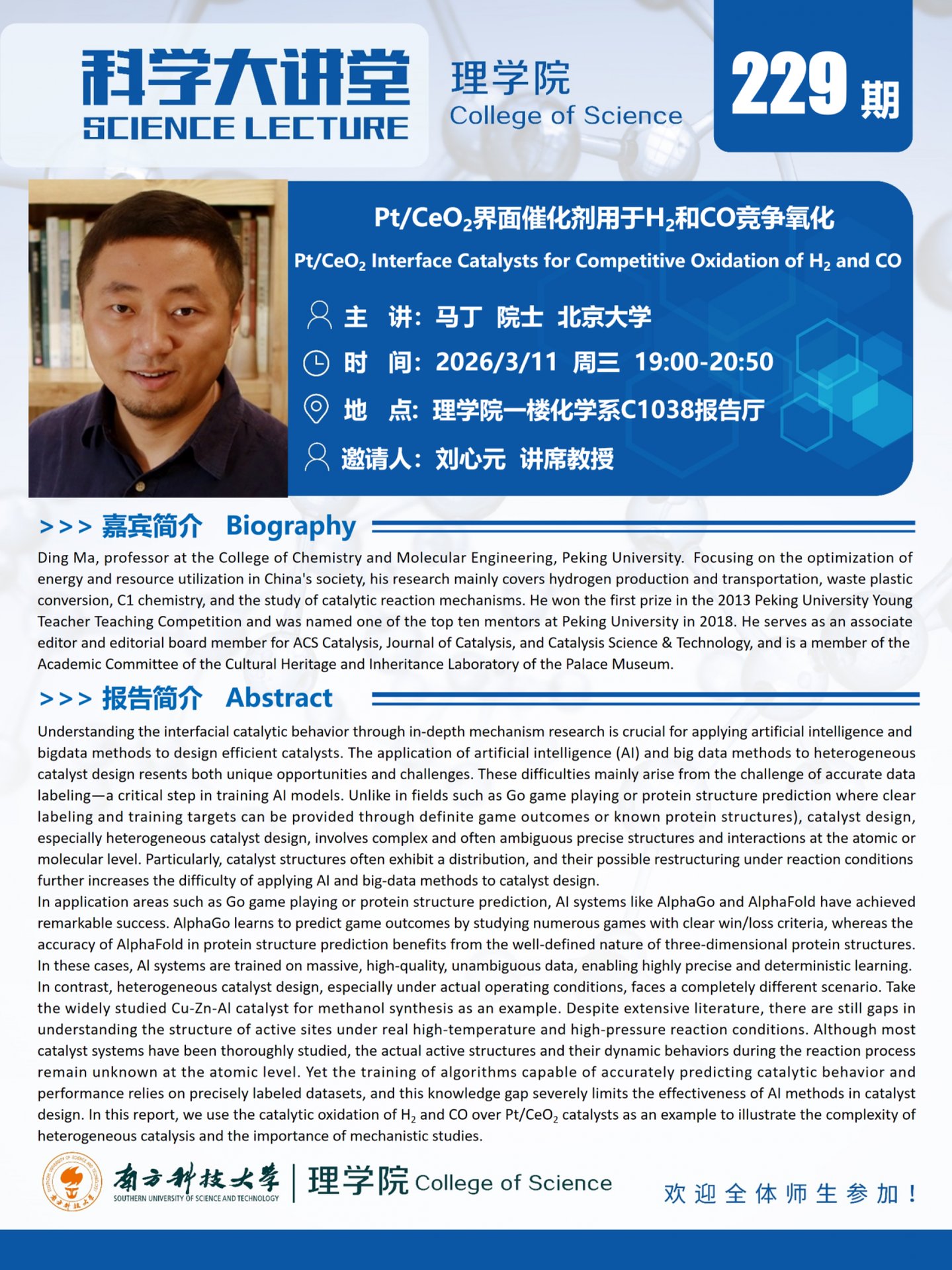
《科学大讲堂 第229期》马丁 院士:Pt/CeO2界面催化剂用于H2和CO竞争氧化
- 题目: Pt/CeO2界面催化剂用于H2和CO竞争氧化
- 主讲人:马丁 院士 @ 北京大学
- 时间:2026年3月11日 19:00-20:50
- 地点:理学院一楼化学系C1038报告厅
主讲人简介
Ding Ma, professor at the College of Chemistry and Molecular Engineering, Peking University. Focusing on the optimization of energy and resource utilization in China's society, his research mainly covers hydrogen production and transportation, waste plastic conversion, C1 chemistry, and the study of catalytic reaction mechanisms. He won the first prize in the 2013 Peking University Young Teacher Teaching Competition and was named one of the top ten mentors at Peking University in 2018. He serves as an associate editor and editorial board member for ACS Catalysis, Journal of Catalysis, and Catalysis Science & Technology, and is a member of the Academic Committee of the Cultural Heritage and Inheritance Laboratory of the Palace Museum.
讲座简介
Understanding the interfacial catalytic behavior through in-depth mechanism research is crucial for applying artificial intelligence and bigdata methods to design efficient catalysts. The application of artificial intelligence (AI) and big data methods to heterogeneous catalyst design resents both unique opportunities and challenges. These difficulties mainly arise from the challenge of accurate data labeling—a critical step in training AI models. Unlike in fields such as Go game playing or protein structure prediction where clear labeling and training targets can be provided through definite game outcomes or known protein structures), catalyst design, especially heterogeneous catalyst design, involves complex and often ambiguous precise structures and interactions at the atomic or molecular level. Particularly, catalyst structures often exhibit a distribution, and their possible restructuring under reaction conditions further increases the difficulty of applying AI and big-data methods to catalyst design. In application areas such as Go game playing or protein structure prediction, AI systems like AlphaGo and AlphaFold have achieved remarkable success. AlphaGo learns to predict game outcomes by studying numerous games with clear win/loss criteria, whereas the accuracy of AlphaFold in protein structure prediction benefits from the well-defined nature of three-dimensional protein structures. In these cases, AI systems are trained on massive, high-quality, unambiguous data, enabling highly precise and deterministic learning. In contrast, heterogeneous catalyst design, especially under actual operating conditions, faces a completely different scenario. Take the widely studied Cu-Zn-Al catalyst for methanol synthesis as an example. Despite extensive literature, there are still gaps in understanding the structure of active sites under real high-temperature and high-pressure reaction conditions. Although most catalyst systems have been thoroughly studied, the actual active structures and their dynamic behaviors during the reaction process remain unknown at the atomic level. Yet the training of algorithms capable of accurately predicting catalytic behavior and performance relies on precisely labeled datasets, and this knowledge gap severely limits the effectiveness of AI methods in catalyst design. In this report, we use the catalytic oxidation of H2 and CO over Pt/CeO2 catalysts as an example to illustrate the complexity of heterogeneous catalysis and the importance of mechanistic studies.
海报链接