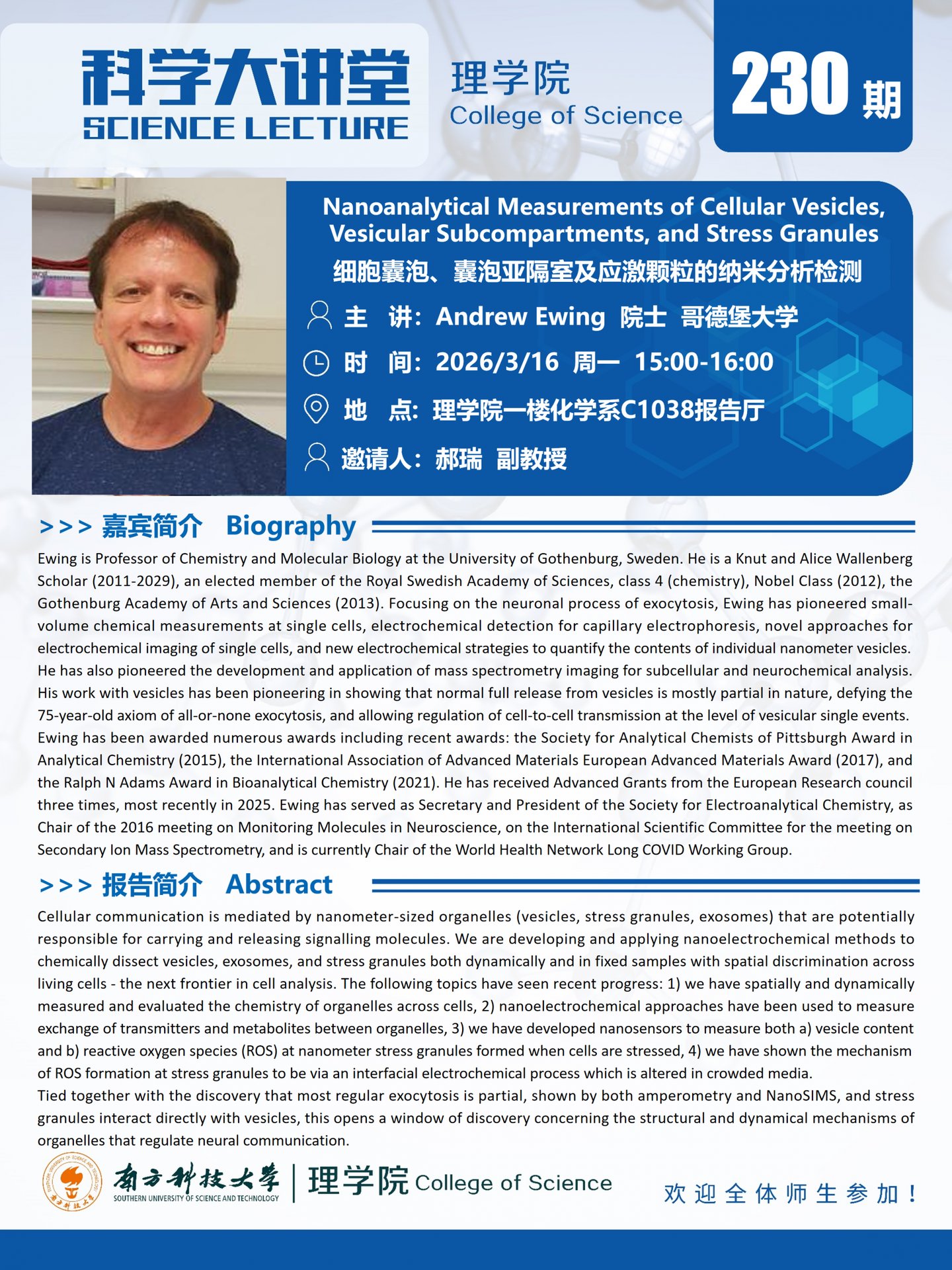
《科学大讲堂 第230期》Andrew Ewing 院士:细胞囊泡、囊泡亚隔室及应激颗粒的纳米分析检测
以下内容根据公开信息整理,并经大模型处理生成,可能存在疏漏或误差,请以实际信息为准。
- 题目: 细胞囊泡、囊泡亚隔室及应激颗粒的纳米分析检测
- 主讲人:Andrew Ewing 院士 @ 哥德堡大学
- 时间:2026年3月16日 15:00-16:00
- 地点:理学院一楼化学系C1038报告厅
主讲人简介
Ewing is Professor of Chemistry and Molecular Biology at the University of Gothenburg, Sweden. He is a Knut and Alice Wallenberg Scholar (2011-2029), an elected member of the Royal Swedish Academy of Sciences, class 4 (chemistry), Nobel Class (2012), the Gothenburg Academy of Arts and Sciences (2013). Focusing on the neuronal process of exocytosis, Ewing has pioneered small-volume chemical measurements at single cells, electrochemical detection for capillary electrophoresis, novel approaches for electrochemical imaging of single cells, and new electrochemical strategies to quantify the contents of individual nanometer vesicles. He has also pioneered the development and application of mass spectrometry imaging for subcellular and neurochemical analysis. His work with vesicles has been pioneering in showing that normal full release from vesicles is mostly partial in nature, defying the 75-year-old axiom of all-or-none exocytosis, and allowing regulation of cell-to-cell transmission at the level of vesicular single events. Ewing has been awarded numerous awards including recent awards: the Society for Analytical Chemists of Pittsburgh Award in Analytical Chemistry (2015), the International Association of Advanced Materials European Advanced Materials Award (2017), and the Ralph N Adams Award in Bioanalytical Chemistry (2021). He has received Advanced Grants from the European Research council three times, most recently in 2025. Ewing has served as Secretary and President of the Society for Electroanalytical Chemistry, as Chair of the 2016 meeting on Monitoring Molecules in Neuroscience, on the International Scientific Committee for the meeting on Secondary Ion Mass Spectrometry, and is currently Chair of the World Health Network Long COVID Working Group.
讲座简介
Cellular communication is mediated by nanometer-sized organelles (vesicles, stress granules, exosomes) that are potentially responsible for carrying and releasing signalling molecules. We are developing and applying nanoelectrochemical methods to chemically dissect vesicles, exosomes, and stress granules both dynamically and in fixed samples with spatial discrimination across living cells - the next frontier in cell analysis. The following topics have seen recent progress: 1) we have spatially and dynamically measured and evaluated the chemistry of organelles across cells, 2) nanoelectrochemical approaches have been used to measure exchange of transmitters and metabolites between organelles, 3) we have developed nanosensors to measure both a) vesicle content and b) reactive oxygen species (ROS) at nanometer stress granules formed when cells are stressed, 4) we have shown the mechanism of ROS formation at stress granules to be via an interfacial electrochemical process which is altered in crowded media. Tied together with the discovery that most regular exocytosis is partial, shown by both amperometry and NanoSIMS, and stress granules interact directly with vesicles, this opens a window of discovery concerning the structural and dynamical mechanisms of organelles that regulate neural communication.
海报链接