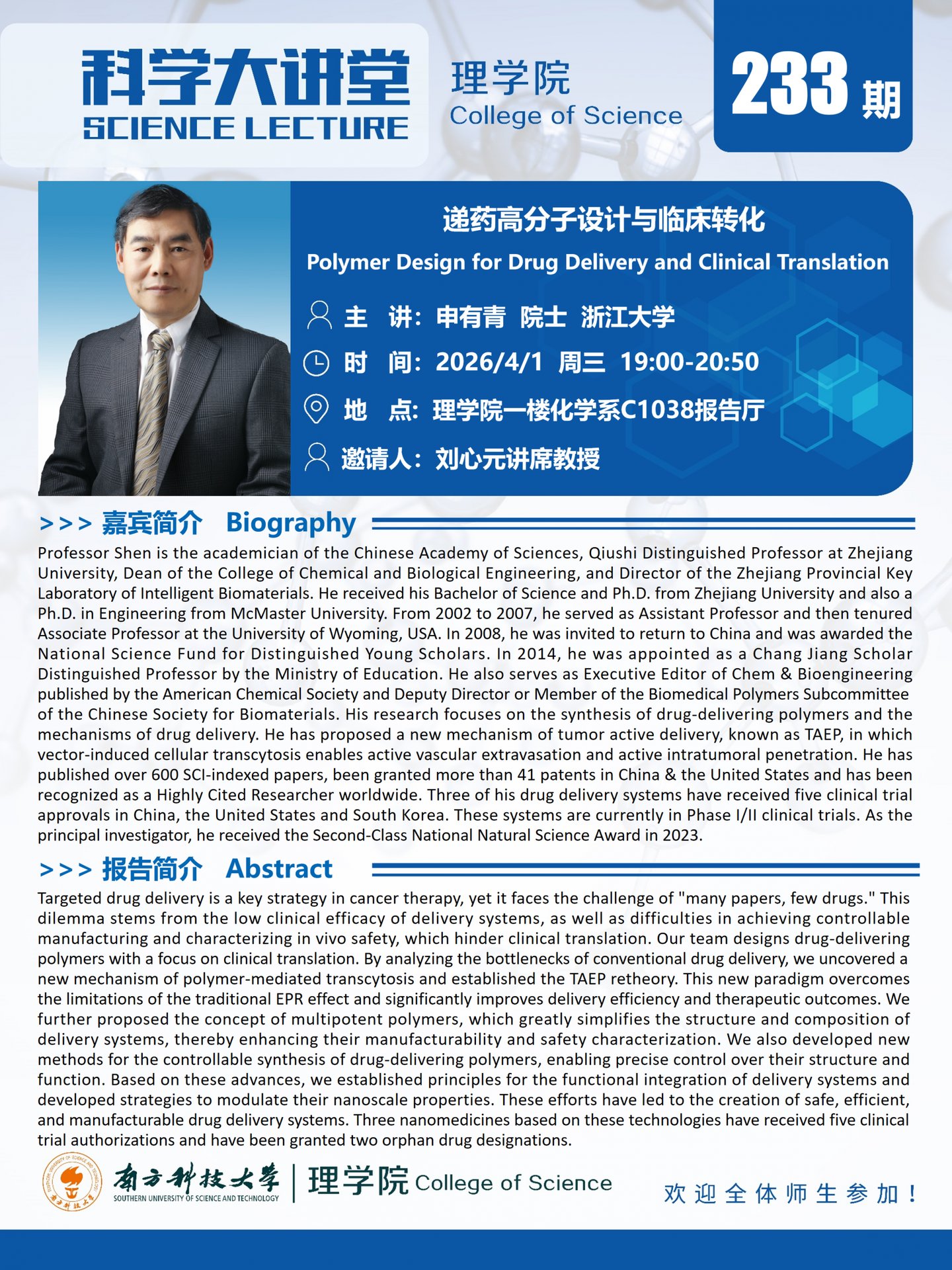
《科学大讲堂系列第233期》申有青 院士:递药高分子设计与临床转化
- 题目: 递药高分子设计与临床转化
- 主讲人:申有青 院士 @ 浙江大学
- 时间:2026年4月1日 星期三 19:00-20:50
- 地点:理学院一楼化学系C1038报告厅
主讲人简介
Professor Shen is the academician of the Chinese Academy of Sciences, Qiushi Distinguished Professor at Zhejiang University, Dean of the College of Chemical and Biological Engineering, and Director of the Zhejiang Provincial Key Laboratory of Intelligent Biomaterials. He received his Bachelor of Science and Ph.D. from Zhejiang University and also a Ph.D. in Engineering from McMaster University. From 2002 to 2007, he served as Assistant Professor and then tenured Associate Professor at the University of Wyoming, USA. In 2008, he was invited to return to China and was awarded the National Science Fund for Distinguished Young Scholars. In 2014, he was appointed as a Chang Jiang Scholar Distinguished Professor by the Ministry of Education. He also serves as Executive Editor of Chem & Bioengineering published by the American Chemical Society and Deputy Director or Member of the Biomedical Polymers Subcommittee of the Chinese Society for Biomaterials. His research focuses on the synthesis of drug-delivering polymers and the mechanisms of drug delivery. He has proposed a new mechanism of tumor active delivery, known as TAEP, in which vector-induced cellular transcytosis enables active vascular extravasation and active intratumoral penetration. He has published over 600 SCI-indexed papers, been granted more than 41 patents in China & the United States and has been recognized as a Highly Cited Researcher worldwide. Three of his drug delivery systems have received five clinical trial approvals in China, the United States and South Korea. These systems are currently in Phase I/II clinical trials. As the principal investigator, he received the Second-Class National Natural Science Award in 2023.
讲座简介
Targeted drug delivery is a key strategy in cancer therapy, yet it faces the challenge of "many papers, few drugs." This dilemma stems from the low clinical efficacy of delivery systems, as well as difficulties in achieving controllable manufacturing and characterizing in vivo safety, which hinder clinical translation. Our team designs drug-delivering polymers with a focus on clinical translation. By analyzing the bottlenecks of conventional drug delivery, we uncovered a new mechanism of polymer-mediated transcytosis and established the TAEP retheory. This new paradigm overcomes the limitations of the traditional EPR effect and significantly improves delivery efficiency and therapeutic outcomes. We further proposed the concept of multipotent polymers, which greatly simplifies the structure and composition of delivery systems, thereby enhancing their manufacturability and safety characterization. We also developed new methods for the controllable synthesis of drug-delivering polymers, enabling precise control over their structure and function. Based on these advances, we established principles for the functional integration of delivery systems and developed strategies to modulate their nanoscale properties. These efforts have led to the creation of safe, efficient, and manufacturable drug delivery systems. Three nanomedicines based on these technologies have received five clinical trial authorizations and have been granted two orphan drug designations.
海报链接