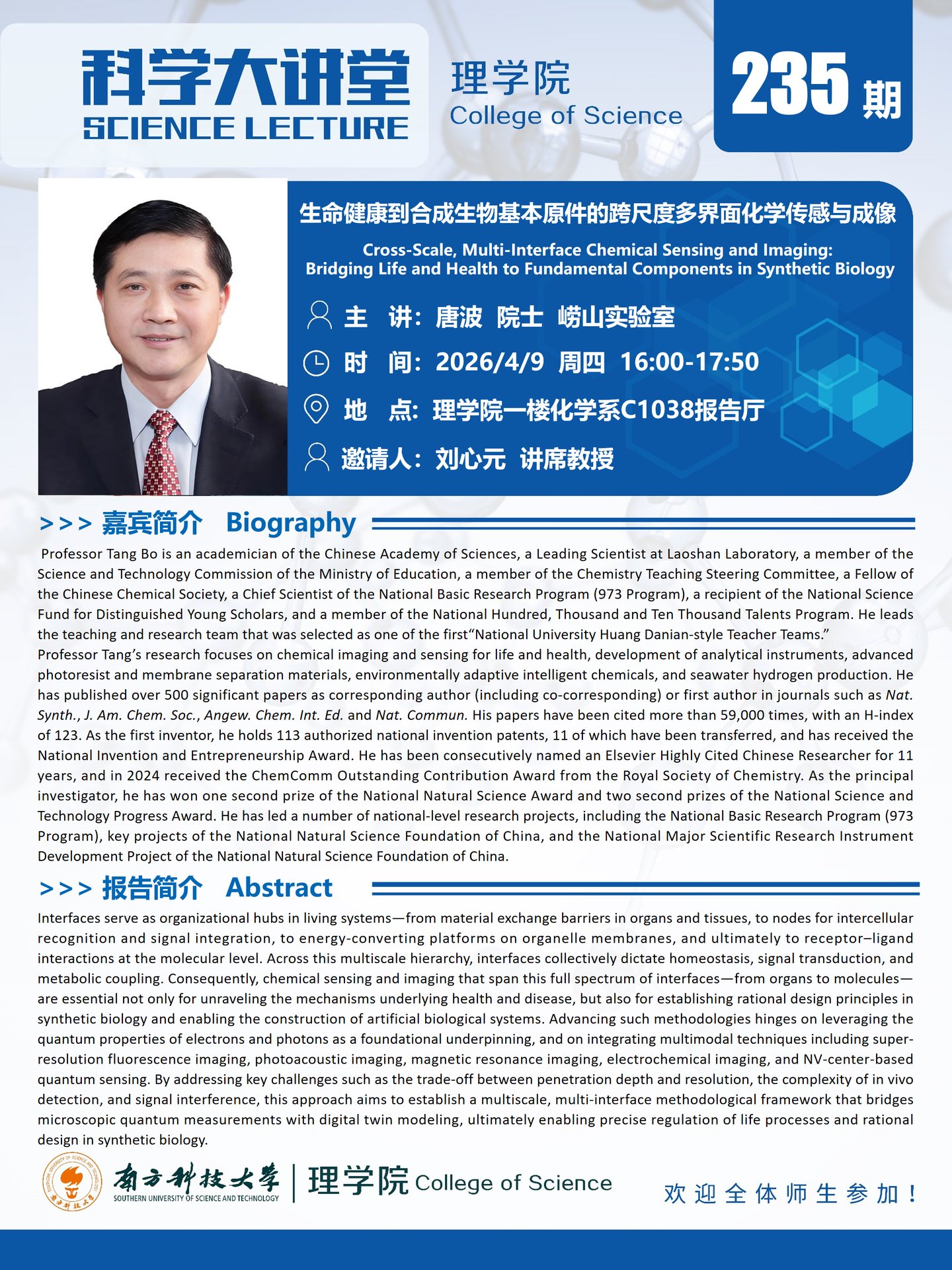
《科学大讲堂 第235期》唐波 院士:生命健康到合成生物基本原件的跨尺度多界面化学传感与成像
以下内容根据公开信息整理,并经大模型处理生成,可能存在疏漏或误差,请以实际信息为准。
- 题目: 生命健康到合成生物基本原件的跨尺度多界面化学传感与成像
- 主讲人:唐波 院士 @ 崂山实验室
- 时间:2026年4月9日 16:00-17:50
- 地点:理学院一楼化学系C1038报告厅
主讲人简介
唐波教授是中国科学院院士,崂山实验室首席科学家,教育部科学技术委员会委员,高等学校理科化学类专业教学指导委员会委员,中国化学会会士,国家重点基础研究发展计划(973计划)首席科学家,国家杰出青年科学基金获得者,国家“百千万人才工程”入选者。他领导的教研团队入选首批“全国高校黄大年式教师团队”。唐教授的研究聚焦于生命健康化学成像与传感、分析仪器开发、先进光刻胶和膜分离材料、环境自适应智能化学品及海水制氢。他在《Nature Synthesis》、《美国化学会志》、《德国应用化学》和《自然通讯》等期刊以通讯作者(含共同通讯)或第一作者身份发表重要论文500余篇。论文引用超过59,000次,H指数为123。作为第一发明人,他拥有113项授权国家发明专利,其中11项已转让,并获得国家发明创业奖。他连续11年入选爱思唯尔中国高被引学者,并于2024年获英国皇家化学学会《Chemical Communications》卓越贡献奖。作为项目负责人,他获一项国家自然科学奖二等奖和两项国家科学技术进步奖二等奖。他主持了多项国家级科研项目,包括国家重点基础研究发展计划(973计划)、国家自然科学基金重点项目和国家重大科研仪器研制项目。
讲座简介
Interfaces serve as organizational hubs in living systems—from material exchange barriers in organs and tissues, to nodes for intercellular recognition and signal integration, to energy-converting platforms on organelle membranes, and ultimately to receptor–ligand interactions at the molecular level. Across this multiscale hierarchy, interfaces collectively dictate homeostasis, signal transduction, and metabolic coupling. Consequently, chemical sensing and imaging that span this full spectrum of interfaces—from organs to molecules—are essential not only for unraveling the mechanisms underlying health and disease, but also for establishing rational design principles in synthetic biology and enabling the construction of artificial biological systems. Advancing such methodologies hinges on leveraging the quantum properties of electrons and photons as a foundational underpinning, and on integrating multimodal techniques including super-resolution fluorescence imaging, photoacoustic imaging, magnetic resonance imaging, electrochemical imaging, and NV-center-based quantum sensing. By addressing key challenges such as the trade-off between penetration depth and resolution, the complexity of in vivo detection, and signal interference, this approach aims to establish a multiscale, multi-interface methodological framework that bridges microscopic quantum measurements with digital twin modeling, ultimately enabling precise regulation of life processes and rational design in synthetic biology.
海报链接